Our Type 1 Diabetes Story: Building a Legacy of Innovation

Sanofi does not provide medical advice and this information is provided for educational purposes only. Your doctor is the best source of health information. Talk to your doctor if you have any questions about your health or treatment.
Every November, American Diabetes Month offers an opportunity to recognize the people and families affected by diabetes – and to reflect on how far we've come together.
For the type 1 (T1D) community specifically, this moment of reflection couldn’t come at a better time. With 64,000 people diagnosed with T1D each year in the United States – many of whom find out about their disease in emergency settings – the need for expanded disease education is critical. As innovation accelerates and paradigms shift, so too must our commitment to empowering people with T1D to make informed decisions about their care.
To understand the pace of change now underway, it helps to look back at how it is directly impacting those living with T1D — from their daily realities to the science advancing their care.
The Human Impact of T1D
Alison was no stranger to the T1D when she was first diagnosed in an early stage – she had watched her sister navigate its day-to-day realities of Stage 3 T1D long before her own diagnosis.
As Alison recalls: “Watching my sister Kate go through her diagnosis made T1D very real for me. When I was diagnosed, I was scared, but I also had time to learn about what was happening and my options. My mom, my family and I became very involved in the T1D community, and those experiences helped me understand the disease and what it could mean for our family.”

Sanofi Patient Ambassadors Alisha and Alison pose together.
It's around this time that she and her mother, Alisha, learned about TZIELD® (teplizumab-mzwv injection 2mg/2mL – a prescription medicine used to delay the onset of Stage 3 type 1 diabetes (T1D) in adults and children 1 year of age and older who have Stage 2 T1D. It is not known if TZIELD is safe and effective in children under 1 year of age who have Stage 2 T1D. There is limited evidence of TZIELD being safe and effective in people 45 years of age and older with Stage 2 T1D. TZIELD is not effective as a disease modifying therapy in non-autoimmune dysglycemic conditions. These are conditions when your blood sugar goes too high and is not caused by your immune system. Do not take TZIELD if you have a weakened immune system (immunocompromised) or have an active viral infection such as EBV or CMV infection. Keep reading for the full Important Safety Information and Prescribing Information.
At the time when Alisha and Alison learned about this option, TZIELD was approved to delay the onset of Stage 3 T1D in adults and children ages 8 and older with Stage 2 T1D.
"When I reached Stage 2, I wanted to consider a different path for myself. After talking with my doctor, my family and others in the T1D community, I decided to move forward with TZIELD. I’m grateful I had that opportunity,” Alison said.
Alisha and Alison’s experience reflects how earlier identification can help families move from uncertainty toward understanding. Their story also highlights the importance of ensuring that people at risk for or diagnosed with T1D have access to information, a support system, and trusted healthcare professionals.
The Science Driving Progress in T1D
Scientific advancements in T1D made stories like Alisha and Alison's possible — and progress continues. In April 2026, TZIELD was approved to delay the onset of Stage 3 T1D in children aged one year and above diagnosed with Stage 2 T1D. The expansion marked another step forward in addressing T1D earlier in the disease process, extending the opportunity to act earlier to a younger population.
Mattias Wieloch, Head of US Autoimmune T1D at Sanofi, views this milestone as an opportunity to address longstanding unmet patient needs.
"When it comes to disease management, young children with T1D often face unique challenges – especially given their small size, limited vocabulary and dependence on caregivers," Wieloch said. "It's for this reason why the opportunity to delay the onset of Stage 3 T1D is so important – and why this moment represents an important milestone in T1D care.”
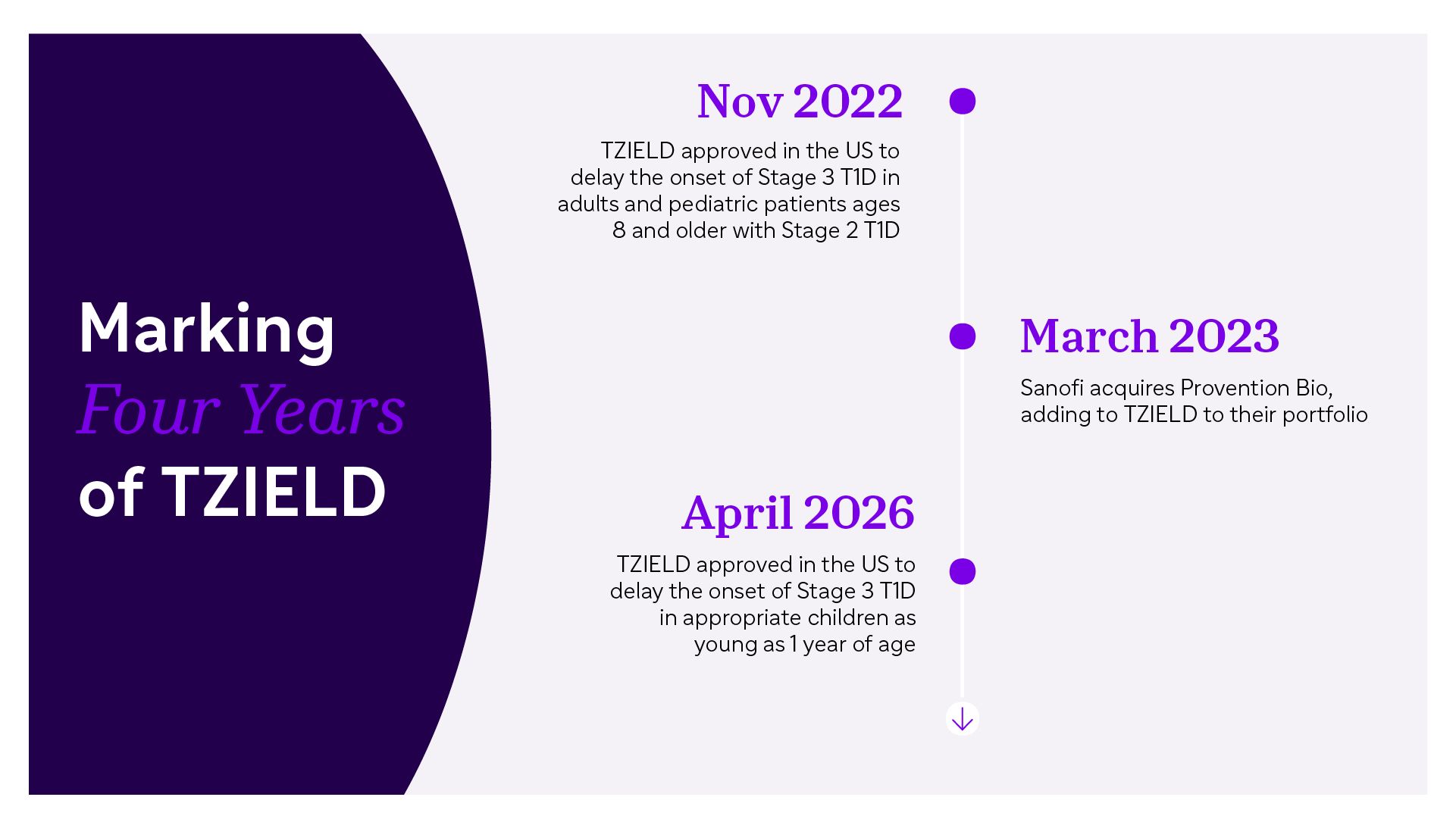
Timeline marking four years of TZIELD milestones.
Our Commitment to T1D
Ask anyone in the T1D community and they're likely to say the same thing: We're entering a bold and exciting new era in this space. For Sanofi, our focus is on translating this excitement into action. That means continuing to educate, advocate, and execute with purpose to help those newly diagnosed with T1D understand their options.
Reflecting on the road ahead, Wieloch said, "Across the United States, families are learning more about their risk of developing T1D and may not know what options are available for them. Closing that gap, and making sure awareness moves as fast as the science, is the urgent work now in front of us."
American Diabetes Month offers a moment to celebrate how far we've come and to recommit to the work that still lies ahead. This is an important chapter in T1D care – and we're just getting started.
Alisha and Alison are TZIELD Brand Ambassadors.
What is TZIELD?
TZIELD is a prescription medicine used to delay the onset of Stage 3 type 1 diabetes (T1D) in adults and children 1 year of age and older who have Stage 2 T1D.
It is not known if TZIELD is safe and effective in children under 1 year of age who have Stage 2 T1D.
There is limited evidence of TZIELD being safe and effective in people 45 years of age and older with Stage 2 T1D.
TZIELD is not effective as a disease modifying therapy in non-autoimmune dysglycemic conditions. These are conditions when your blood sugar goes too high and is not caused by your immune system.
Do not take TZIELD if you have a weakened immune system (immunocompromised) or have an active viral infection such as EBV or CMV infection.
IMPORTANT SAFETY INFORMATION
What is the most important information I should know about TZIELD?
TZIELD may cause serious side effects, including:
- Viral Reactivation. Epstein-Barr virus (EBV) and cytomegalovirus (CMV) are common viruses that may stay inactive in your body after an initial infection. TZIELD may cause these viruses to become active again which, especially in people with a weakened immune system, can become serious and potentially life-threatening. These infections can happen during treatment with TZIELD and for up to 2 months after your last dose. Your healthcare provider will test you for active EBV and CMV infections before treatment with TZIELD. Contact your healthcare provider right away if you develop symptoms of an infection during or after treatment with TZIELD (such as fever, swollen glands, or fatigue).
- Cytokine release syndrome (CRS). Signs and symptoms may start during the first 5 days of TZIELD treatment and could include fever, nausea (with or without vomiting), feeling tired (fatigue), headache, muscle and joint pain, or increased liver enzymes in your blood. Tell your healthcare provider right away if you develop any signs and symptoms of CRS during treatment with TZIELD.
- Serious Infections. Treatment with TZIELD may lower your immune system’s ability to fight infections, which may increase your risk of getting a serious infection. TZIELD is not recommended if you currently have a serious infection, or an infection that keeps coming back or does not go away (chronic infection), other than a minor skin infection. Contact your healthcare provider right away if you develop symptoms of an infection during or after treatment with TZIELD such as: fever or chills; redness, warmth, or swelling of the skin; feeling tired; cough or shortness of breath; severe stomach pain or diarrhea.
- Decrease in white blood cells. TZIELD may cause a decrease in a type of white blood cell called lymphocytes. A decrease in white blood cells is a serious, but common side effect that can affect your body’s ability to fight infections. A decrease in white blood cell counts can happen after your first dose. Your white blood cell counts will start to go back to normal after your fifth dose of TZIELD. Some people may develop longer and more severe decreases in lymphocytes.
Your healthcare provider will do blood tests to check for active infections, verify your liver function and your complete blood counts before you start treatment and during treatment with TZIELD. During and after your treatment with TZIELD, your healthcare provider will check for serious side effects, as well as other side effects, and treat you as needed. Your healthcare provider may temporarily or completely stop your treatment with TZIELD, if you develop liver problems, have a serious infection or viral reactivation, or if your blood counts stay too low and treat you as needed. Your healthcare provider may temporarily or completely stop your treatment with TZIELD, if you develop liver problems, have a serious infection or viral reactivation, or if your blood counts stay too low.
What should I tell my healthcare provider before receiving TZIELD?
Before or after receiving TZIELD, tell your healthcare provider about all your medical conditions, including if you:
- have any of the conditions or symptoms listed in the section “What is the most important information I should know about TZIELD?”
- have a weakened immune system, including if you have Down syndrome.
- have a serious infection or an infection that does not go away or keeps coming back (chronic).
- have recently received or are scheduled to receive an immunization (vaccine). TZIELD may affect how well a vaccine works. Tell your healthcare provider that you are receiving treatment with TZIELD before receiving a vaccine. Your healthcare provider will tell you when you can safely receive any vaccine before and after the treatment with TZIELD.
- are pregnant or plan to become pregnant. TZIELD may harm your unborn baby. Do not receive TZIELD during pregnancy and at least 30 days before a planned pregnancy. If you become pregnant while taking TZIELD, you are encouraged to report your pregnancy to us at our Adverse Event reporting line at 1-800-633-1610 or visit https://ae.reporting.sanofi.
- are breastfeeding or plan to breastfeed. It is not known if TZIELD passes into your breast milk and if it can harm your baby. Talk to your healthcare provider about the best way to feed your baby if you receive TZIELD.
Tell your healthcare provider about all the medicines you take, including prescription and over-the-counter medicines, vitamins, and herbal supplements.
What are the possible side effects of TZIELD?
See “What is the most important information I should know about TZIELD?”
Allergic (hypersensitivity) reactions: Serious allergic reactions can happen while receiving TZIELD. Your healthcare provider will watch you closely while you are receiving TZIELD and after your infusion for signs of a reaction. Tell your healthcare provider right away if you have any of the following symptoms of an allergic reaction:
- fever, joint pain, swollen lymph nodes (serum sickness)
- urticaria
- vomiting
- swelling of the face, lips, tongue, or throat (angioedema)
- rash
- trouble breathing
The most common side effects of TZIELD include:
- decrease in white blood cell counts
- vomiting
- rash
- diarrhea
- increased liver enzyme levels
- headache
These are not all of the possible side effects of TZIELD. For more information, ask your healthcare provider or pharmacist. Call your doctor for medical advice about side effects. You may report side effects to the FDA at 1-800-FDA-1088. You may also report side effects to us at 1-800-633-1610 or visit https://ae.reporting.sanofi.
Please click for full Prescribing Information, including Risk of SERIOUS SIDE EFFECTS and Medication Guide.
Explore More

Voices That Carry: Lessons from the T1D Community